Who Are the Best LED Acrylic Letters Suppliers in China?
Choosing a reliable supplier for Led Acrylic Letters takes more than comparing product photos and unit prices. Chinese manufacturers offer many options, from compact reception signs to illuminated storefront lettering. Yet similar-looking samples can differ in acrylic thickness, edge finish, LED spacing, and wiring quality. Details matter.
This guide explores suppliers through practical buyer criteria: production experience, material specifications, customization, quality checks, communication, and after-sales support. A useful first step is requesting clear drawings, close-up photos, and a sample showing the actual light color and brightness. Ask how the supplier checks lettering for uneven illumination, scratches, and loose connections before packing. Small defects can be easy to miss in a polished online gallery.
Price is only part of the decision. Clarify what is included, such as power supplies, mounting hardware, packaging, and shipping preparation. Request written specifications and a realistic production schedule, then compare answers across several suppliers. Consistent, specific replies are more reassuring than broad promises. Still, no checklist can remove every risk. Samples may not capture large-order consistency, and schedules can shift. Keep that in mind.
The supplier profiles and evaluation points ahead are intended to help buyers ask better questions, not to declare one company universally best. The right match depends on project size, design complexity, budget, and required support. Look closely. Then verify.
What Are LED Acrylic Letters? Their 3-Layer Signage Construction
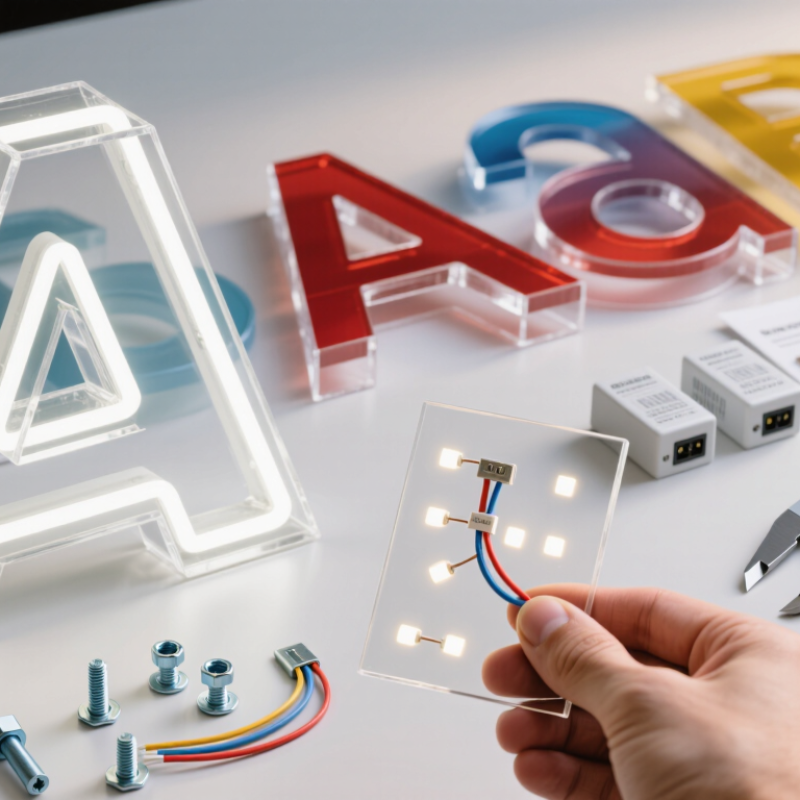
LED acrylic letters are illuminated signs built from three functional layers, not simply glowing plastic. The front face is usually cast acrylic, cut into letter shapes and chosen for color, thickness, and light transmission. Behind it, an LED module sits inside a shallow return, creating the letter’s depth and distributing light across the face. A rear panel closes the housing and supports mounting. Seams, wiring access, and heat management matter too. A bright face can still show dark patches if LEDs are spaced poorly.
Grand View Research estimated the global digital signage market at USD 28.83 billion in 2023. That figure covers many display types, not acrylic letters alone, but it reflects wider investment in visible, illuminated communication. For buyers comparing suppliers in China, ask for a section drawing, LED spacing details, acrylic specifications, and a sample lit for several hours. Check the edges closely. Small differences in returns or diffusion can change the finished look.
Tips: Request a photo of the sign switched on in a dim room, plus one in daylight. Confirm the driver and wiring are accessible for service. Do not judge brightness from a product rendering; real illumination can be less even.
How Are They Made? Acrylic Faces, LED Modules, and Power Supplies
LED acrylic letters are made from several parts that must work together. A translucent acrylic face is usually cut to the letter shape, then fitted to a metal or acrylic return. The face thickness and color affect how evenly light appears. A bright white sample can look different once it is lit from behind. No layout is perfect on paper.
Inside the letter, LED modules are spaced according to the stroke width, depth, and face material. Modules placed too far apart can leave dim patches; crowded modules may create hot spots and waste power. This detail is easy to underestimate. Suppliers should check a lit sample, not rely only on drawings. The power supply is selected from the modules’ total wattage, with suitable operating headroom and ventilation. Wiring should be secured, and the supply’s protection rating should match the installation environment. A final test can reveal flicker, uneven color, or light leaking at the edges. Small defects matter. Even careful production may need adjustment after the first sample, especially when narrow strokes or deep returns change how light spreads.
Which Specs Matter? IP65 Under IEC 60529 and CRI of 80+
When comparing LED acrylic letter suppliers in China, ask for more than an IP65 label. Under IEC 60529, the first digit, 6, indicates dust-tight protection; the second, 5, indicates protection against water jets. The IPX5 test uses a 6.3 mm nozzle delivering about 12.5 litres per minute, with exposure lasting at least three minutes. These are controlled test conditions, not proof that a sign can withstand immersion or poor installation. Check how cable entries, joints, and drainage are handled. Small details matter.
Color quality deserves equal scrutiny. CIE Publication 13.3 assesses general CRI using eight test-color samples, so a CRI of 80+ is a useful baseline, not a complete color guarantee. The standard Ra score does not include saturated red R9. For warm skin tones or red graphics, request measured Ra and R9 results for the actual LED module. Also ask for test records tied to the finished letter, not just a component datasheet. A neat certificate can still leave unanswered questions. Review the light in person, if possible; acrylic color and viewing angle can change the effect.
How to Vet Chinese Suppliers? Check ISO 9001 and LM-80 Test Evidence
When comparing LED acrylic letters suppliers in China, ask for the current ISO 9001 certificate and verify its scope, issuing body, and validity. The certificate should cover the actual production site and relevant manufacturing processes, not just an unrelated office. Request a sample inspection record, material traceability details, and a description of how defects are handled. Paperwork is not proof.
For LED performance, request LM-80 test evidence for the LED package or module used in your proposed sign. Check the tested part number, operating conditions, test duration, and report source. Then compare those details with the supplier’s bill of materials. LM-80 measures lumen maintenance under defined test conditions; it does not certify the complete acrylic sign or guarantee its service life. A mismatch between the report and the installed LEDs deserves a clear explanation.
Ask the supplier to show how incoming LEDs are checked and how batches are tracked from assembly to shipment. If possible, inspect a sample under normal operating conditions and look for uneven brightness, visible hotspots, rough acrylic edges, or loose wiring. In practice, documents may be incomplete or slow to obtain, and that is worth noting rather than ignoring. A careful supplier should answer specific questions without promising more than the test evidence supports.
How to Vet LED Acrylic Letter Suppliers in China
Use this LM-80 test-duration reference when reviewing LED component evidence. It compares test hours, not suppliers.
What to check: Request the complete LM-80 report and confirm it covers the LED package, module, or array used in the sign. Separately verify the supplier’s ISO 9001 certificate, including its validity, issuing body, and scope. LM-80 evidence is not a substitute for an ISO 9001 certificate.
How to Compare Suppliers? Score 5 Factors: Quality, MOQ, Lead Time, Shipping, and Support
Compare LED acrylic letter suppliers with the same five-factor scorecard, using a score from one to five for each factor. Quality deserves close inspection. Request a sample and check its acrylic edges, letter thickness, LED brightness, and color consistency. Look for dark spots when the letters are switched on. Small details matter. A polished sample is useful, but ask how production pieces are checked too.
For MOQ, confirm the minimum order in writing and ask whether mixed sizes or colors count toward it. Compare quoted lead times from approved artwork to dispatch, not just factory production. Shipping scores should reflect protective packing, tracking, and clear responsibility for transit arrangements. Ask support questions before paying: how quickly does the supplier reply, and can they explain installation or troubleshooting clearly? Keep the evidence beside each score, such as a sample photo or dated schedule. One limitation: a neat scorecard cannot predict every delay or batch variation. I would revisit the ratings after a small order, since confidence built from messages alone can be misplaced.
Who Are the Best LED Acrylic Letters Suppliers in China? — How to Compare Suppliers
Compare supplier capabilities across five practical factors. The profiles and scores below are illustrative supplier archetypes, not audited ratings of specific companies. Score each factor from 1 (weaker) to 5 (stronger); higher scores indicate a better fit for that factor.
| Supplier Profile | Quality
(1–5) | Typical MOQ | Typical Production Lead Time | Shipping & Export Readiness
(1–5) | Communication & Support
(1–5) | Quality Score
(1–5) | MOQ Score
(1–5) | Lead-Time Score
(1–5) | Total
(out of 25) |
| Integrated LED sign manufacturer | 4 | Often accepts custom projects from a few letters; confirm setup charges and project minimums. | About 2–4 weeks after artwork approval and order confirmation. | 4 — Usually able to arrange export packing and common freight options. | 4 | 4 | 3 | 4 | 19 |
| Custom acrylic fabrication specialist | 4 | Often flexible for prototypes and small custom runs; pricing may be higher per unit. | About 2–5 weeks, depending on fabrication complexity and finishing. | 3 — Confirm whether export packing and freight coordination are handled in-house. | 3 | 5 | 3 | 18 |
| Export-focused trading and sourcing service | 3 | May offer flexible order quantities, subject to the production factory’s minimums. | About 3–6 weeks; allow time for supplier coordination and quality checks. | 5 — Often experienced with export documents and coordinating international freight. | 3 | 4 | 3 | 17 |
| Small-batch signage workshop | 3 | Often suitable for samples, replacements, and small projects. | About 1–3 weeks for straightforward orders; workload can affect timing. | 3 — Check packing standards and who is responsible for export arrangements. | 4 | 5 | 4 | 19 |
| Large-volume OEM production factory | 4 | May require larger batches or higher order value, especially for customized production. | About 3–6 weeks after specifications and production capacity are confirmed. | 4 — Typically suited to palletized or consolidated shipments; verify packaging details. | 3 | 2 | 4 | 17 |
How to compare: Request photos or samples, LED and power-supply specifications, material details, a written production schedule, packaging dimensions, and a clear warranty policy. Lead times shown are indicative production estimates and exclude international transit, customs clearance, and delays caused by design revisions. Shipping cost and transit time depend on destination, shipment size, and service selected. Confirm all MOQ, lead-time, shipping, and support terms in writing before ordering.