China Top LED Lighting Manufacturers for Global Buyers
Choosing among China’s top LED lighting manufacturers requires more than comparing catalog prices. Global buyers need evidence of engineering depth, production consistency, and long-term support. A bright sample can impress on day one. It may still fail after months of heat, dust, voltage changes, or frequent switching.
James R. Benya, a respected lighting designer and LED industry expert, once explained, “LEDs are not light bulbs; they are a completely different technology.” This distinction matters when evaluating Led Lighting suppliers. Strong manufacturers design the complete system, including LEDs, drivers, heat sinks, optics, controls, and protective housings. Their teams should explain lumen maintenance, color consistency, power factor, surge protection, and thermal performance in practical terms.
Look beyond polished showrooms. Request test reports, production samples, warranty conditions, and factory quality procedures. Check whether the same LED bin and driver specifications remain available for future orders. Inspect soldering, cable sealing, surface finishing, and packaging details. A reliable supplier welcomes difficult questions.
Not every large factory is the right partner. That is easy to forget. Some buyers also focus too heavily on unit cost. A lower price can conceal weaker components, unstable color output, or expensive replacements.
This guide introduces leading Chinese manufacturers for commercial, industrial, architectural, roadway, and residential applications. It considers product range, customization capability, export experience, certifications, quality controls, and communication practices. The rankings are not absolute. Project requirements differ, and even reputable suppliers may need careful verification before purchase.
China’s LED Advantage: 75% Lower Energy Use per U.S. DOE Benchmarks
China Top LED Lighting Manufacturers for Global Buyers
China’s LED advantage is not only a lower purchase price. It is measurable energy performance. U.S. Department of Energy benchmarks commonly show LED lighting using up to 75% less energy than incandescent lighting. The exact saving depends on the original lamp, operating hours, and control system. A 60-watt incandescent bulb can often be replaced by an LED using about 9 watts. In a warehouse running twelve hours daily, that difference becomes visible on the electricity bill.
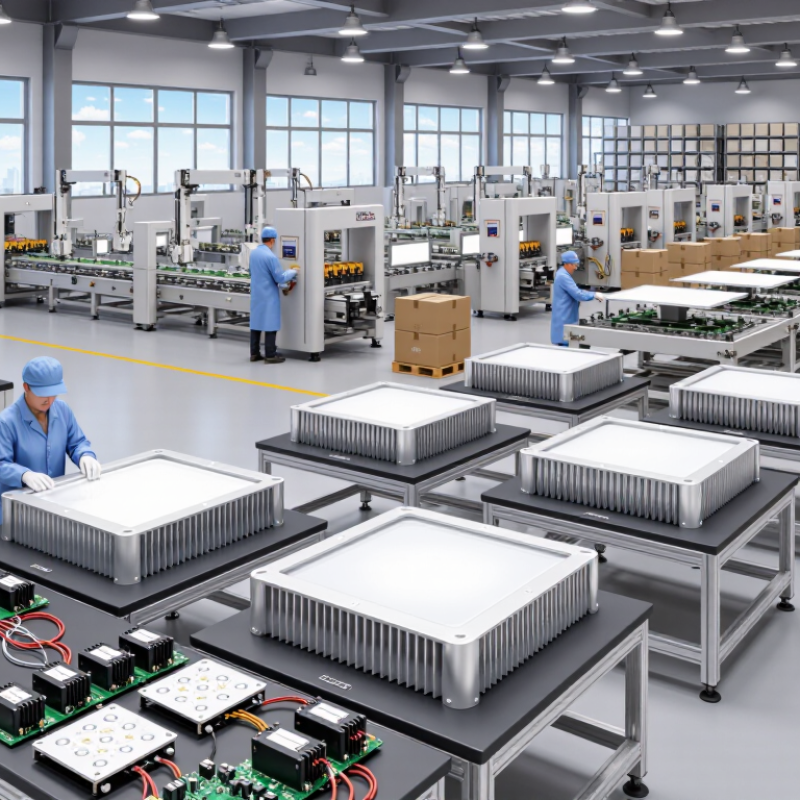
China’s manufacturing ecosystem supports this efficiency through large-scale component supply, automated assembly, and extensive testing capacity. Experienced manufacturers can provide lighting for offices, factories, streets, hotels, and retail spaces. Buyers should request photometric files, driver specifications, efficiency data, and safety certifications before approving samples. A low wattage label alone proves little. Heat management matters. Poor thermal design can reduce brightness and shorten service life.
The numbers are promising.
Still, energy savings are not automatic. Incorrect beam angles may create dark areas, encouraging users to install more fixtures. Cheap drivers can also produce flicker or early failure. I have seen projects focus heavily on unit price while overlooking maintenance access and replacement labor. That is a costly blind spot. Reliable sourcing requires sample testing, clear warranty terms, production inspections, and verification under the intended voltage and climate. DOE benchmarks provide a useful reference, not a guarantee for every installation.
How to Rank Manufacturers: Efficacy, CRI ≥80, Lifetime, and Warranty
When global buyers compare LED lighting manufacturers, efficacy is a practical starting point. Check delivered lumens per watt, not only the laboratory claim. A fixture producing 150 lm/W may perform differently after optics, housing, and driver losses. Ask for test reports from qualified laboratories, with operating temperature and input conditions clearly stated. Small details matter.
CRI should be at least 80 for general commercial applications. However, CRI alone can hide weak red rendering. Review R9 values when lighting food, retail displays, or hospitality spaces. Request a sample and inspect colors under real ceiling conditions. It is easy to trust a spreadsheet too quickly. I have found that glare, flicker, and uneven distribution can matter more than a higher efficacy figure.
Lifetime claims need careful reading. L70 indicates when output may fall to 70 percent of its initial level, not when the lamp stops working. Confirm the test temperature, driver quality, and maintenance assumptions. A credible manufacturer should provide LM-80 and TM-21 evidence where applicable, plus clear warranty terms. Check coverage years, exclusions, replacement procedures, and the party responsible for shipping. Longer warranties are useful, but only when the supplier can support them after installation. One overlooked point is thermal design. Dust, enclosed fixtures, and high ambient temperatures can shorten real service life. Some specifications still ignore this.
Top Chinese Manufacturers by Category: Chips, Drivers, Fixtures, and Smart LEDs
China Top LED Lighting Manufacturers for Global Buyers
Chinese LED manufacturers are strongest when buyers assess the supply chain by category. Chip makers usually compete on luminous efficacy, bin consistency, and thermal stability. The U.S. Department of Energy reports that modern LEDs can use at least 75% less energy than incandescent lighting. However, chip quality alone does not guarantee field performance. Request LM-80 data, thermal test results, and documented batch traceability.
Driver suppliers require different checks. Review power factor, surge protection, flicker percentage, dimming compatibility, and operating temperature. IEC test reports matter, but they should match the exact model being shipped. Fixture manufacturers add optics, heat sinks, housings, and sealing details. Look for IP ratings, photometric files, salt-spray testing, and clear replacement policies. Small details matter here. A loose gasket can ruin an outdoor project.
Smart LED suppliers should support reliable protocols, cybersecurity updates, and local control options. MarketsandMarkets estimates that the smart lighting market could grow from about USD 15.9 billion in 2024 to USD 39.2 billion by 2030. Yet forecasts are not purchase guarantees. Global buyers should test interoperability before placing volume orders. DALI-2, Bluetooth Mesh, and Wi-Fi products may behave differently across gateways. The weak point is often integration, not brightness. A factory may show excellent samples, while production consistency remains uncertain. Independent inspection, aging tests, and a small pilot order provide stronger evidence than a polished showroom.
Global Compliance Checklist: CE, RoHS, UL, LM-80, and TM-21 Evidence
China Top LED Lighting Manufacturers for Global Buyers
A credible supplier should provide a compliance file before shipment. Request the CE Declaration of Conformity, test standards, and product model details. CE marking indicates conformity with applicable European requirements, not superior performance. RoHS evidence should identify restricted substances and laboratory methods. XRF screening is useful, but it may not replace chemical testing for every material. Small gaps matter.
For North American projects, ask whether UL certification covers the complete luminaire. A component certificate may not cover wiring, housing, or thermal design. Verify the file number, product scope, voltage, and production site.
The U.S. Department of Energy reports that LED lighting can use at least 75% less energy than incandescent lighting and last up to 25 times longer. Actual results depend on heat management and controls (U.S. DOE, Energy Saver).
LM-80 reports should show LED package testing, drive current, case temperature, and lumen maintenance over time. TM-21 calculations then project useful life from that measured evidence. Do not accept “50,000 hours” without the test report and calculation sheet.
The IEA estimates lighting represents about 15% of global electricity use, so efficiency claims deserve careful checking (IEA, Energy Efficiency 2023).
I have seen attractive files with mismatched model numbers. Recheck them.
Buyer Comparison Matrix: MOQ, Lead Time, IP65, Warranty, and Total Cost
China Top LED Lighting Manufacturers for Global Buyers
Buyer Comparison Matrix: MOQ, Lead Time, IP65, Warranty, and Total Cost
A useful supplier matrix turns vague promises into comparable evidence. Record MOQ by model, not by factory-wide averages. A 500-unit MOQ may fit a warehouse project but fail a pilot order. Details matter. Ask whether the quoted lead time includes production, testing, and export packing. In practice, a 25-day estimate can become 40 days when customized housings require approval.
IP65 should be supported by test reports, product drawings, and clear sealing details. Check the rating for the complete assembled fixture, not only its LED module. Review operating temperature, cable glands, and connector protection. These small parts often decide field performance. Warranty terms also need careful reading. Compare coverage length, failure definitions, replacement procedures, and freight responsibilities. A five-year warranty sounds strong, but weak response terms reduce its practical value.
Total cost must include tooling, samples, inspection, packaging, shipping, duties, installation, and expected replacements. Compare costs over the product’s service life, not only the unit price. A lower-priced fixture may consume more power or require earlier maintenance. Independent testing improves confidence, although paperwork is never a perfect substitute for factory audits. I would also request a pilot batch and photograph incoming goods. The matrix will still contain uncertainty. That is normal. Recheck every critical figure before signing.
China Top LED Lighting Manufacturers for Global Buyers
Buyer Comparison Matrix: MOQ, Lead Time, IP65, Warranty, and Total Cost
This anonymized benchmark compares five typical China LED lighting supplier profiles using commonly quoted export terms. Total cost is an estimated landed cost for 1,000 standard outdoor LED fixtures, excluding import duties and local taxes. Lower MOQ, shorter lead time, longer warranty, higher IP65 coverage, and lower total cost generally indicate stronger purchasing value.