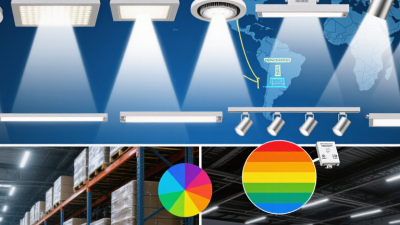
How to Choose Commercial Industrial Lighting?
Choosing Commercial Industrial Lighting is not a matter of buying the brightest fixtures. The right system must suit the work, the building, and the people using it. A loading bay needs clear visibility across moving vehicles. A production line may need steady, even light that helps workers inspect small parts. Those are different demands.
Lighting designer Howard M. Brandston is often credited with the reminder, “Lighting is not about seeing; it is about feeling.” That idea matters in industrial spaces, where harsh glare can cause fatigue and uneven light can hide details. Still, a memorable quote cannot replace measurements. Start by examining ceiling height, task locations, operating hours, ambient temperature, and existing wiring. Then compare light output, distribution, color rendering, glare control, energy use, and maintenance access. Small details count. A fixture that looks efficient on paper may be awkward to clean above a dusty machine.
This guide explains how to evaluate those choices without treating one product as right for every facility. It will cover LED options, mounting styles, controls, durability, and total operating cost. Check product specifications, certifications, and warranty terms against the actual site conditions; confirm critical decisions with a qualified lighting professional. One caution: projected savings depend on usage patterns and installation quality. Numbers deserve a second look. A practical selection balances visibility, worker comfort, reliability, and cost—and accepts that some trade-offs remain.
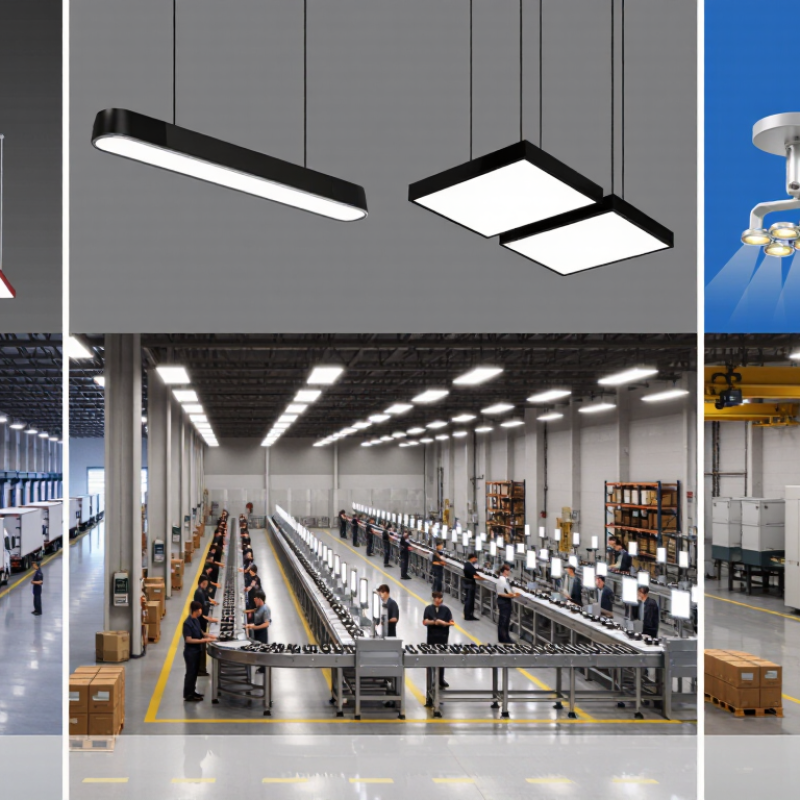
Define Work Tasks and Set Illuminance Using IES RP-7-21
Choosing industrial lighting starts with the work, not the fixture.
IES RP-7-21, Lighting Industrial Facilities, links recommended illuminance to visual tasks and their difficulty. A worker moving cartons needs different light from someone checking small weld defects. Walk the process line and record task locations, viewing distances, surface colors, and inspection details.
Small details matter.
Use maintained illuminance at the actual work plane, not a bright reading beneath one luminaire.
As a planning example, coarse handling may begin near 200 lux, while detailed inspection may call for around 500 lux. Verify these starting points against the relevant RP-7-21 task category and project conditions.
Measure after installation, too. Dust, aging, and blocked light reduce delivered illuminance over time. Check uniformity and glare alongside average lux; a high reading cannot reveal a dark inspection bench.
A tidy drawing can still mislead. Real production floors are less tidy.
Revisit the design with workers during a normal shift, especially where tasks change or shadows cross the work surface.
Choose Warehouse Ambient Levels of 10–30 fc; Increase Light for Detailed Tasks
For general warehouse areas, aim for 10–30 foot-candles (fc), measured across the occupied floor. That is roughly 108–323 lux. The Illuminating Engineering Society’s RP-7-21, Lighting for Industrial Facilities, takes a task-based approach: light levels should reflect what workers need to see. A clear aisle may work near the lower end; sorting labels or checking stock may need more. Measure where the work happens, not just beneath a fixture.
Detailed tasks deserve additional light. Packing stations, inspection benches, and small-print labels may call for around 50 fc or more, depending on contrast and viewing distance. Use localized task lighting where possible, rather than raising every fixture across the building. This can limit glare and unnecessary energy use. Small details matter.
Check the space during a real shift. Tall racks can cast long shadows, while dusty lenses and aging surfaces reduce useful light over time. I would not pretend one number fits every bay. Record readings at the work surface, then ask workers where labels disappear or shadows slow them down. Recheck after layout changes, too; a brighter plan can still miss the task.
Compare Luminaire Efficacy in lm/W and Check DLC Qualified Product Listings
Start with luminaire efficacy, expressed in lumens per watt (lm/W). It shows how much light a complete fixture produces for each watt it uses. Compare fixtures with similar lumen output, color temperature, optics, and dimming settings. Otherwise, a high lm/W figure may look attractive while delivering the wrong light to the work area. Check the test data, not just a product-page claim. Small differences matter.
Use the DLC Qualified Product Listings as a cross-check. Search for the exact model number and configuration, since a suffix can indicate a different driver, output, or control option. Confirm that the listed efficacy and product details match the fixture being quoted. A qualification helps establish that a product meets defined performance criteria; it does not prove that the fixture suits every building or task.
Then compare the numbers with the space itself. A warehouse aisle with tall racks needs a different distribution pattern from a low-ceiling workshop. Review mounting height, spacing, and the manufacturer’s photometric data alongside lm/W. Still, numbers have limits. A spreadsheet cannot show every shadow cast by a beam or a shelf. Check whether the proposed layout provides useful light where workers need it, and whether dimming or sensor settings could change actual power use.
Specify CRI ≥80 and IEC 60529 IP Ratings for Color and Environmental Needs
For warehouses, workshops, and inspection bays, specify CRI (Ra) ≥80 when workers must distinguish labels, wire colors, or surface defects. CIE 13.3-1995 defines the Ra color-rendering method, but one score cannot describe every color shift. The Illuminating Engineering Society’s TM-30-20 reports fidelity (Rf) and gamut (Rg) separately. That extra detail helps when painted parts or produce must look consistent under mixed lighting. CRI 80 is a sensible baseline, not a promise of perfect color. I would check samples at the actual workbench; drawings rarely reveal an unpleasant green cast.
Match enclosure protection to exposure, not just the room name. IEC 60529 assigns IP codes with separate dust and water digits: IP54 is dust-protected and resists splashing water, while IP65 is dust-tight and protected against water jets. A loading-bay luminaire near washdown spray may need more protection than an office fixture, yet the cleaning method matters. Check test conditions and mounting orientation, then inspect seals and cable entries during installation. Small gaps count. Also consider condensation, chemical cleaners, and temperature cycling; an IP rating alone does not certify resistance to these conditions. This is easy to overlook.
Evaluate Controls, Rated Life, and Energy Savings Before Selecting Fixtures
Choosing commercial industrial lighting means checking controls against the actual work area. In a warehouse, occupancy sensors can dim or switch off lights in empty aisles; daylight sensors can reduce output near skylights. A Lawrence Berkeley National Laboratory meta-analysis found average lighting-energy savings of 24% for occupancy sensors and 28% for daylighting controls. These are study averages, not guarantees. Layout, operating hours, and commissioning matter. A sensor aimed at a moving forklift may behave differently than expected. Test settings on site.
Rated life deserves equal care. The U.S. Department of Energy’s solid-state lighting guidance describes LED lifetime using measures such as L70, when light output has fallen to 70% of its initial level. Check the fixture’s rated life, test conditions, and driver information—not just a headline hour figure. Dust, heat, and frequent switching can change maintenance needs. I still question a long-life claim if its test details are missing.
Then compare energy use with the controls included. The LBNL report found savings varied by control strategy, so avoid applying one percentage to every facility. Review fixture wattage, expected daily hours, and the utility rate; estimate savings against the existing system. A short trial can expose uneven light or nuisance shutoffs before a full installation. That matters.